
 Tiếng Việt
 中文 (中国)

From 2012 to 2020, the industrial and high-tech shrimp farming model (pond liner) has grown fast due to the new technology development trend of the times. Problems such as small farming areas, big profits, and high stocking density lead to the use of many chemicals and antibiotics. It adversely affects not only the health of consumers but also the quality of shrimp. In addition, it also impacts the prices and the exports situation of this one. Besides, overusing chemicals and antibiotics in shrimp farming pollutes wastewater and increases disease outbreaks, leading to harmful pathogens that are resistant to antibiotics. Moreover, farming areas and water resources are also shrunk due to pollution.
To overcome these problems and contribute to shrimp farming in a sustainable direction in the future, you may apply an eco-friendly farming method or use microbiological or probiotics for all shrimp farming models.
There are some advantages when culturing shrimp by microbiological
– Limiting environmental pollution and risks caused by disease
– Shrimp grow fast and reach large sizes
– Shrimp have high-valuable, are not infected with antibiotics, and reach an export quality.
– Low cost and high profit
Recommendations when culturing shrimp by microbiological
– Selecting reputable, quality, and disease-free postlarvae hatcheries. Currently, Binh Minh Aquaculture Development Co., Ltd produces disease resistance postlarvae sources.
– The stocking density should be appropriate according to each model
For black tiger shrimp
Extensive farming: < 1 individual / m2
Semi-intensive farming: < 5 individuals / m2
Intensive farming: < 10 individuals / m2
For white leg shrimp
Extensive farming: < 5 individuals / m2
Semi-intensive farming: < 20 individuals / m2
Intensive farming: < 100 individuals / m2
Super intensive farming: < 150 individuals / m3
– The farming model should have a settling pond, pond preparation, and culturing pond.
– Water entering the pond must be settled and filtered (with a net of fewer than 50 micrometers).
– Using probiotics to overwhelm harmful bacteria at least 3 times before stocking
– Checking the density of harmful bacteria (under 100-200 CFU)
– For earthen and extensive ponds, it is necessary to supplement probiotics at least two times in 10-15 days before stocking.
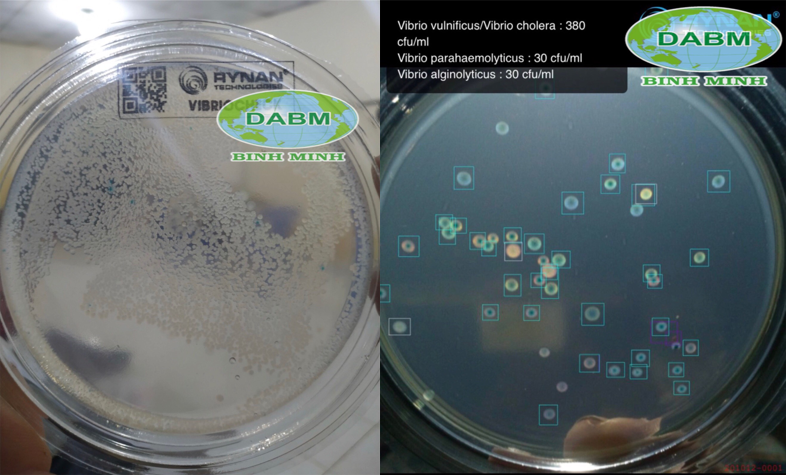
Image of some harmful bacteria
DOMESTICATED SHRIMP POSTLARVAE – THE KEY TO SUCCESS
See more:
- Shrimp market Update: facing new challenges
- Bioremediation For Profitable Vannamei Shrimp Farming
- Ecuador hosts global shrimp buyers for second shrimp summit
SẢN PHẨM PHỤC VỤ NỀN NÔNG NGHIỆP XANH
TIN TỨC NỔI BẬT
A comparison of resource use in shrimp farming, part 3: Energy
Shrimp farming in the five major exporting countries could use less energy by focusing on [...]
Sep
A comparison of resource use in shrimp farming, part 2: Water
Shrimp farming uses very little freshwater directly – only that required for drinking purposes, sanitation [...]
Sep
A comparison of resource use in shrimp farming, part 1: Land
The intensity of shrimp production could be greatly increased without any additional direct land use [...]
Sep
Study finds marine amphipods can upcycle crop waste into aquaculture feeds
Researchers found marine amphipods can convert agricultural waste into nutritious ingredient for aquaculture feeds Researchers [...]
Sep
Water quality impacts on health and performance of fish and shrimp, Part 3: The nitrogenous compounds ammonia, nitrite and nitrate
Effective monitoring and management of ammonia, nitrite and nitrate are essential in intensive aquaculture systems, [...]
Sep
Nitrogen isotopes help researchers verify fishmeal sources for aquafeeds
Nitrogen isotope signatures can verify fishmeal use in aquaculture diets, potentially improving seafood traceability Researchers [...]
Aug
Water quality impacts on health and performance of fish and shrimp, Part 2: pH, carbon dioxide, alkalinity, hardness and the water buffering system
Although there is a general consensus on the importance of water quality, many farmers still [...]
Aug
Impact of Novel Feed Ingredients on Growth, Digestibility, Enzymes, and Gene Expression in Pacific White Shrimp, Penaeus vannamei
As aquaculture strives for sustainability, replacing fish meal in shrimp diets remains a challenge. This [...]
Jul
Effects of Shrimp Aquaculture on Mangrove Soil Carbon Stocks and Sustained-Flux Global Warming Potentials
Mangrove forests provide critical ecosystem services, including serving as nursery habitats for fish, protecting coastlines [...]
Jul
Warming-Driven Migration of Enterotypes Mediates Host Health and Disease Statuses in Ectotherm Litopenaeus vannamei
With modern industrialization and urbanization, global warming has become a serious threat to ecosystems, especially [...]
Jul
Pivotal Roles of Fish Nutrition and Feeding: Recent Advances and Future Outlook for Brazilian Fish Farming
As global aquaculture shifts toward ecological responsibility, Brazil’s nutritional strategies are evolving to reduce reliance on [...]
Jul
Analyze of Production Performance of Shrimp Litopenaeus vannamei Culture and Water Quality on Earthen Pond Quality on Earthen Pond and HDPE-Lined Pond
As global demand for seafood continues to rise, aquaculture faces increasing pressure to optimize production [...]
Jul