
 Tiếng Việt
 中文 (中国)

Shrimp farming uses very little freshwater directly – only that required for drinking purposes, sanitation and a few other farm uses
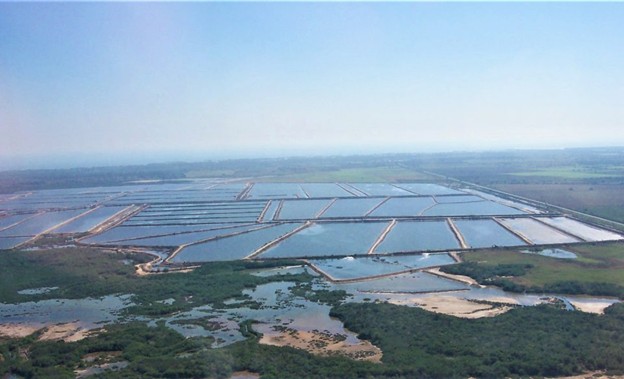
Much is said about present and future water shortages. However, the world has as much water today as it ever did and as much as it ever will. Water shortages result from droughts, population expansion into arid regions, poor management of water supplies, conflicts within and between nations, expansion of irrigated agriculture and, as with all resources, human greed.
Data for water use in shrimp farming reported here were obtained from surveys of whiteleg shrimp (Pacific white shrimp, Litopenaeus vannamei) farms in the five major shrimp reporting countries. The number of farms included for each country were as follows: 101 in Ecuador; 89 in India; 131 in Indonesia; 34 in Thailand; and 30 in Vietnam. The data were summarized in greater detail in a review article (see Aquaculture, Fish and Fisheries 2021, 1–13).
Water use in shrimp farming
Annual, sustainable and available freshwater for human use is typically considered to be non-flood stage stream flow plus storage in dams on large rivers. Much groundwater is used, but shallow groundwater use competes with non-flood stage stream flow. Deeper groundwater sources may require many years for recharge and groundwater usually is not included in the sustainable water for human use.
Shrimp farming uses very little freshwater directly – only that which is required for drinking purposes, sanitation and a few other farm uses. Freshwater is necessary for the production of feeds, fuels and other management inputs. Such water use is typically known as embodied water use. The reason for including saline water is that energy is used for pumping water into shrimp farms and water discharged from farms contains pollutants.
The amount of saline water used by farms in the five-country survey depended upon the method of water management. Farms that did not rely on water exchange during the crop used the least water per metric ton of shrimp. Some farms not using water exchange reused a portion of the water drained at harvest, further reducing water use.
The percentage of farms using daily water exchange ranged from 94 percent in Indonesia to 21 percent in India (Table 1) with a weighted average for all countries of 67 percent. At farms applying water exchange, the amount of saline water used increased with the daily rate of water exchange which varied from 1 to 40 percent of production pond volume per day. Average daily water exchange rates varied from 5 percent in Thailand to 21 percent in India (Table 1) with a weighted average for the five countries of 8.0 percent pond volume per day.
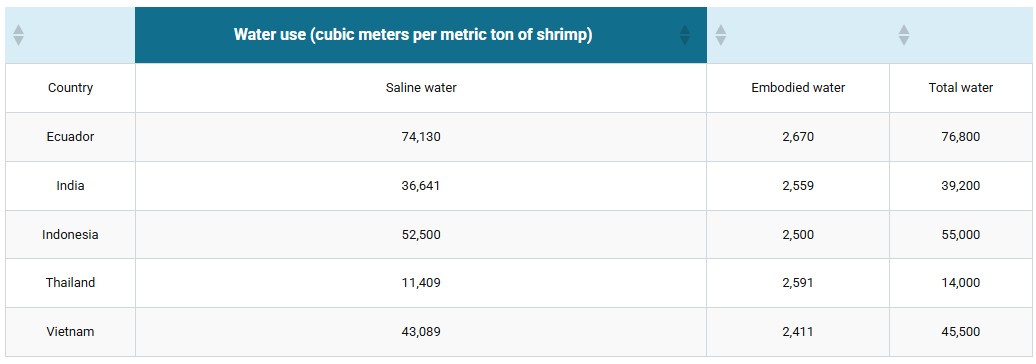
Saline water use ranged from 11,409 cubic meters per metric ton (MT) of shrimp in Thailand to 74,130 cubic meters per MT of shrimp in Ecuador (Table 1). The weighted average for the five countries was 50,146 cubic meters per MT of shrimp. Thailand used more aeration per hectare and Ecuador used less aeration than other countries. Nevertheless, there was no obvious decline in water exchange rate as aeration rate increased.
Embodied freshwater represented a small fraction of total water use (Table 1), and there was little variation in embodied water use among countries (2,411-2,670 cubic meters per MT shrimp) with a weighted average of all countries of 2,557 cubic meters per MT of shrimp. Only 4.3 percent of the weighted total water use of 52,700 cubic meters per MT of shrimp was embodied freshwater. We did not include all freshwater use, because no data were obtained for direct freshwater use on farms for drinking, sanitation and other farm uses. However, this use was thought to be rather small.
The main use of embodied freshwater was for feed. Production of plant crops requires considerable water, and plant meals and other shrimp feed ingredients contained 1,261–2,179 cubic meters of embodied water per MT of feed with an average of 1,612 cubic meters per MT of feed. Nearly all of the embodied freshwater in farmed shrimp resulted from the feed.
While total water use by shrimp farming is quite large, less than 5 percent of water use was freshwater. Farmed shrimp do not appear to be of concern in freshwater use. However, by improving the FCR, freshwater use can be reduced for farmed shrimp.
Pollutants and management
The greater concern related to water use is the large amount of water discharged from farms. This water has elevated concentrations of suspended solids (and turbidity), nitrogen, phosphorus and biological oxygen demand (BOD). When released into natural water, it may result in turbidity plumes and sedimentation around outfalls. It also may stimulate phytoplankton growth and increase the demand for oxygen, leading to eutrophication.
Ponds are very effective in removing a portion of the pollutants from water. Microbial decomposition reduces the oxygen demand, the major nitrogenous compound is ammonia; ammonia is converted to less troublesome nitrate by nitrification; nitrate is converted by denitrification to gaseous nitrogen, which diffuses into the air; phosphorus is sequestered by sediment. Water exchange shortens the hydraulic retention time in ponds, resulting in less removal of pollutants in ponds and more pollutants are discharged into receiving waters.
The pollutants in shrimp farm effluent derive primarily from uneaten feed, feces and shrimp metabolism. Steps for reducing the pollution potential of shrimp farms include conservative feeding practices to avoid as much uneaten feed as possible; to have adequate aeration to prevent low dissolved oxygen concentration, which negatively affects shrimp appetite; and to monitor aerobic microbial activity, including nitrification. Water exchange should be reduced to lengthen the hydraulic retention time and increase waste assimilation in ponds. Less water exchange also conserves energy by reducing pumping requirement.
By Claude E. Boyd, Robert P. Davis, Aaron McNevin
Source: https://www.globalseafood.org/advocate/a-comparison-of-resource-use-in-shrimp-farming-part-2-water/
Read more:
- Can brown mussel meal in feed promote growth and cold resistance of Pacific white shrimp?
- Improving salinity tolerance in tilapia
- A singular focus: Making single-cell proteins a fixture on the aquaculture feed ingredient menu
SẢN PHẨM PHỤC VỤ NỀN NÔNG NGHIỆP XANH
TIN TỨC NỔI BẬT
A comparison of resource use in shrimp farming, part 3: Energy
Shrimp farming in the five major exporting countries could use less energy by focusing on [...]
Sep
A comparison of resource use in shrimp farming, part 2: Water
Shrimp farming uses very little freshwater directly – only that required for drinking purposes, sanitation [...]
Sep
A comparison of resource use in shrimp farming, part 1: Land
The intensity of shrimp production could be greatly increased without any additional direct land use [...]
Sep
Study finds marine amphipods can upcycle crop waste into aquaculture feeds
Researchers found marine amphipods can convert agricultural waste into nutritious ingredient for aquaculture feeds Researchers [...]
Sep
Water quality impacts on health and performance of fish and shrimp, Part 3: The nitrogenous compounds ammonia, nitrite and nitrate
Effective monitoring and management of ammonia, nitrite and nitrate are essential in intensive aquaculture systems, [...]
Sep
Nitrogen isotopes help researchers verify fishmeal sources for aquafeeds
Nitrogen isotope signatures can verify fishmeal use in aquaculture diets, potentially improving seafood traceability Researchers [...]
Aug
Water quality impacts on health and performance of fish and shrimp, Part 2: pH, carbon dioxide, alkalinity, hardness and the water buffering system
Although there is a general consensus on the importance of water quality, many farmers still [...]
Aug
Impact of Novel Feed Ingredients on Growth, Digestibility, Enzymes, and Gene Expression in Pacific White Shrimp, Penaeus vannamei
As aquaculture strives for sustainability, replacing fish meal in shrimp diets remains a challenge. This [...]
Jul
Effects of Shrimp Aquaculture on Mangrove Soil Carbon Stocks and Sustained-Flux Global Warming Potentials
Mangrove forests provide critical ecosystem services, including serving as nursery habitats for fish, protecting coastlines [...]
Jul
Warming-Driven Migration of Enterotypes Mediates Host Health and Disease Statuses in Ectotherm Litopenaeus vannamei
With modern industrialization and urbanization, global warming has become a serious threat to ecosystems, especially [...]
Jul
Pivotal Roles of Fish Nutrition and Feeding: Recent Advances and Future Outlook for Brazilian Fish Farming
As global aquaculture shifts toward ecological responsibility, Brazil’s nutritional strategies are evolving to reduce reliance on [...]
Jul
Analyze of Production Performance of Shrimp Litopenaeus vannamei Culture and Water Quality on Earthen Pond Quality on Earthen Pond and HDPE-Lined Pond
As global demand for seafood continues to rise, aquaculture faces increasing pressure to optimize production [...]
Jul