
 Tiếng Việt
 中文 (中国)
Researchers found marine amphipods can convert agricultural waste into nutritious ingredient for aquaculture feeds
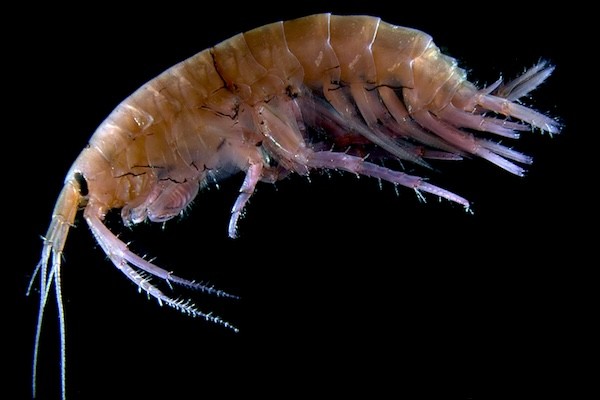
Researchers at the University of Aveiro have found that marine amphipods can convert agricultural byproducts into an aquafeed ingredient rich in essential omega-3 fatty acids, offering a potential way to reduce aquaculture’s reliance on nutrients derived from wild fish.
The findings, from the university’s PUFApods project, suggest the tiny crustaceans could provide a sustainable use for agricultural waste while producing biomass containing the omega-3 fatty acids eicosapentaenoic acid (EPA) and docosahexaenoic acid (DHA), which are important for farmed fish and subsequently for human health.
The researchers studied Gammarus locusta, a marine amphipod that naturally feeds on decaying organic matter. They found the animals maintained relevant levels of EPA and DHA across multiple generations, even when fed diets made entirely from vegetable byproducts such as peas and bell peppers.
To evaluate the approach over the long term, the team tracked three generations of amphipods raised on plant-based diets and compared them with amphipods fed conventional fish feed.
Amphipods fed pea-based diets reproduced at rates similar to those fed conventional feed, while those fed bell peppers reproduced less successfully and reached sexual maturity later. Even though the plant-based diets contained no EPA or DHA, the amphipods maintained relevant levels of the fatty acids, suggesting they can convert plant-based feed into a valuable source of marine omega-3s.
The researchers also found that the diet of parent amphipods influenced the fatty acid composition of their offspring, indicating that broodstock nutrition could affect the nutritional profile of future generations.
According to the research team, Gammarus locusta could be integrated into recirculating aquaculture systems, integrated multi-trophic aquaculture operations and traditional pond farms with minimal infrastructure changes. Because the animals can feed on agricultural by-products and other organic waste streams, they could provide farmers with an additional source of high-value biomass.
The researchers said the approach could help reduce pressure on wild fish stocks while supporting circular bioeconomy principles by converting agricultural waste into valuable aquaculture products.
By Responsible Seafood Advocate
Read more:
- Translucent Post-larvae Disease beyond China: From outbreak recognition to diagnostic readiness
- Listening to the pond bottom: How bioacoustics can transform shrimp feeding management
- Bacterial mixtures from live-feed microalgae shows promise as alternative to antibiotics for aquaculture
SẢN PHẨM PHỤC VỤ NỀN NÔNG NGHIỆP XANH
TIN TỨC NỔI BẬT
Study finds marine amphipods can upcycle crop waste into aquaculture feeds
Researchers found marine amphipods can convert agricultural waste into nutritious ingredient for aquaculture feeds Researchers [...]
Sep
Water quality impacts on health and performance of fish and shrimp, Part 3: The nitrogenous compounds ammonia, nitrite and nitrate
Effective monitoring and management of ammonia, nitrite and nitrate are essential in intensive aquaculture systems, [...]
Sep
Nitrogen isotopes help researchers verify fishmeal sources for aquafeeds
Nitrogen isotope signatures can verify fishmeal use in aquaculture diets, potentially improving seafood traceability Researchers [...]
Aug
Water quality impacts on health and performance of fish and shrimp, Part 2: pH, carbon dioxide, alkalinity, hardness and the water buffering system
Although there is a general consensus on the importance of water quality, many farmers still [...]
Aug
Impact of Novel Feed Ingredients on Growth, Digestibility, Enzymes, and Gene Expression in Pacific White Shrimp, Penaeus vannamei
As aquaculture strives for sustainability, replacing fish meal in shrimp diets remains a challenge. This [...]
Jul
Effects of Shrimp Aquaculture on Mangrove Soil Carbon Stocks and Sustained-Flux Global Warming Potentials
Mangrove forests provide critical ecosystem services, including serving as nursery habitats for fish, protecting coastlines [...]
Jul
Warming-Driven Migration of Enterotypes Mediates Host Health and Disease Statuses in Ectotherm Litopenaeus vannamei
With modern industrialization and urbanization, global warming has become a serious threat to ecosystems, especially [...]
Jul
Pivotal Roles of Fish Nutrition and Feeding: Recent Advances and Future Outlook for Brazilian Fish Farming
As global aquaculture shifts toward ecological responsibility, Brazil’s nutritional strategies are evolving to reduce reliance on [...]
Jul
Analyze of Production Performance of Shrimp Litopenaeus vannamei Culture and Water Quality on Earthen Pond Quality on Earthen Pond and HDPE-Lined Pond
As global demand for seafood continues to rise, aquaculture faces increasing pressure to optimize production [...]
Jul
Listening to the pond bottom: How bioacoustics can transform shrimp feeding management
Study shows acoustic monitoring overcomes water turbidity limitation, optimizes growth and reveals novel behavioral patterns [...]
Jul
Translucent Post-larvae Disease beyond China: From outbreak recognition to diagnostic readiness
Recent studies are providing shrimp hatcheries with stronger tools to recognize, characterize and screen for [...]
Jul
Killing methods, post-slaughter quality, part 1
Developing a slaughter program Harvesting fish for slaughter usually requires some handling and concentration of [...]
Mar