
 Tiếng Việt
 中文 (中国)

Study shows acoustic monitoring overcomes water turbidity limitation, optimizes growth and reveals novel behavioral patterns under varying environmental conditions
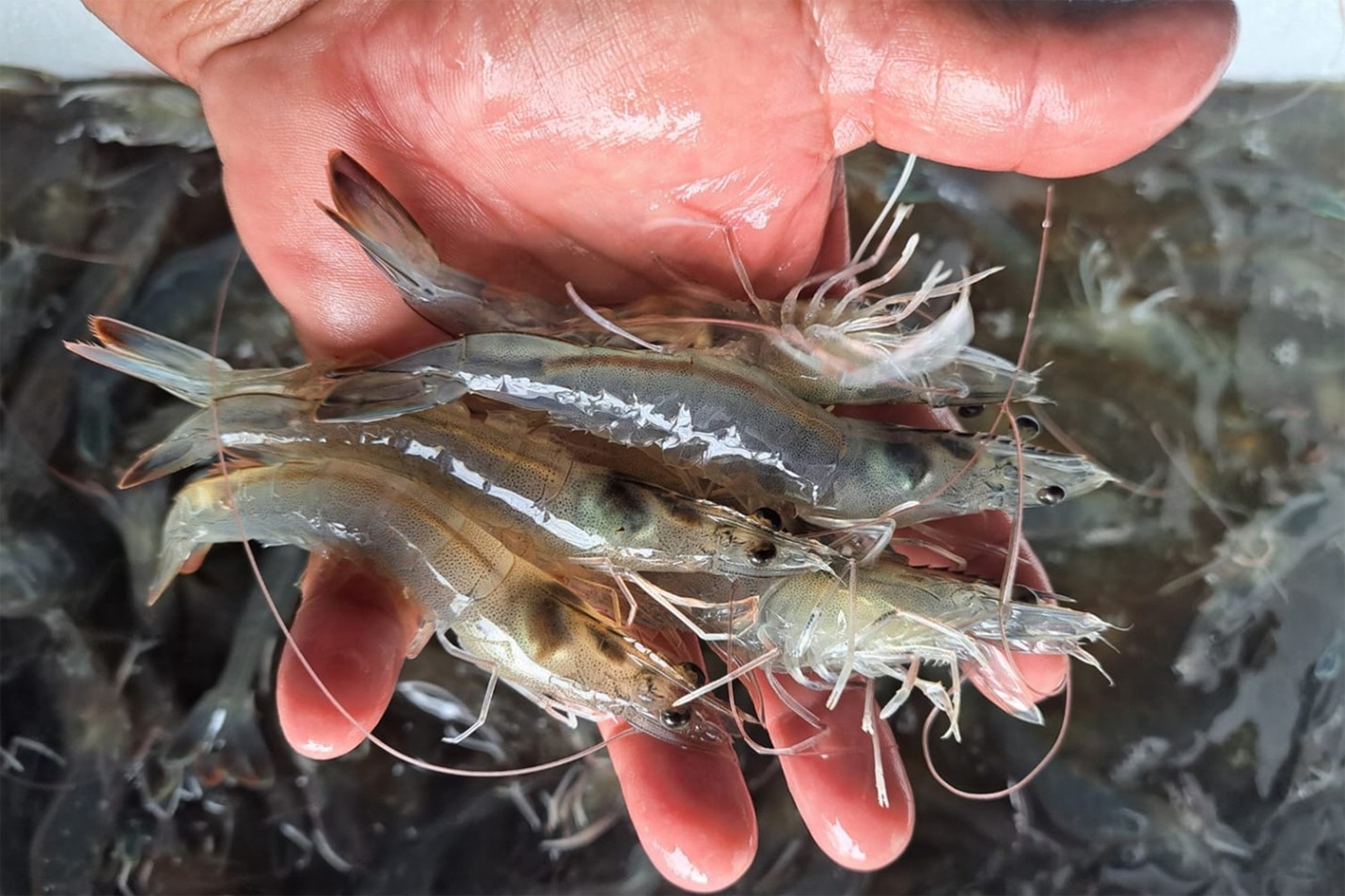
As Pacific white shrimp (Penaeus vannamei) consolidates its economic importance in aquaculture, the intensification of farming highlights a major challenge: monitoring benthic animals in ponds with high turbidity. Because microalgae and bacterial communities obscure the water column, visual monitoring of shrimp feeding behavior becomes virtually impossible. Traditionally, producers rely on manual feeding with the aid of submerged trays, which are labor-intensive and provide only retrospective and late assessments of feed consumption.
This lack of real-time visibility entails serious economic and environmental risks. Feed is the highest variable cost in shrimp production, representing 50–60 percent of total operating expenses. Overfeeding compromises profitability and rapidly degrades water quality as uneaten pellets decompose in the pond bottom, while underfeeding limits growth and extends production cycles.
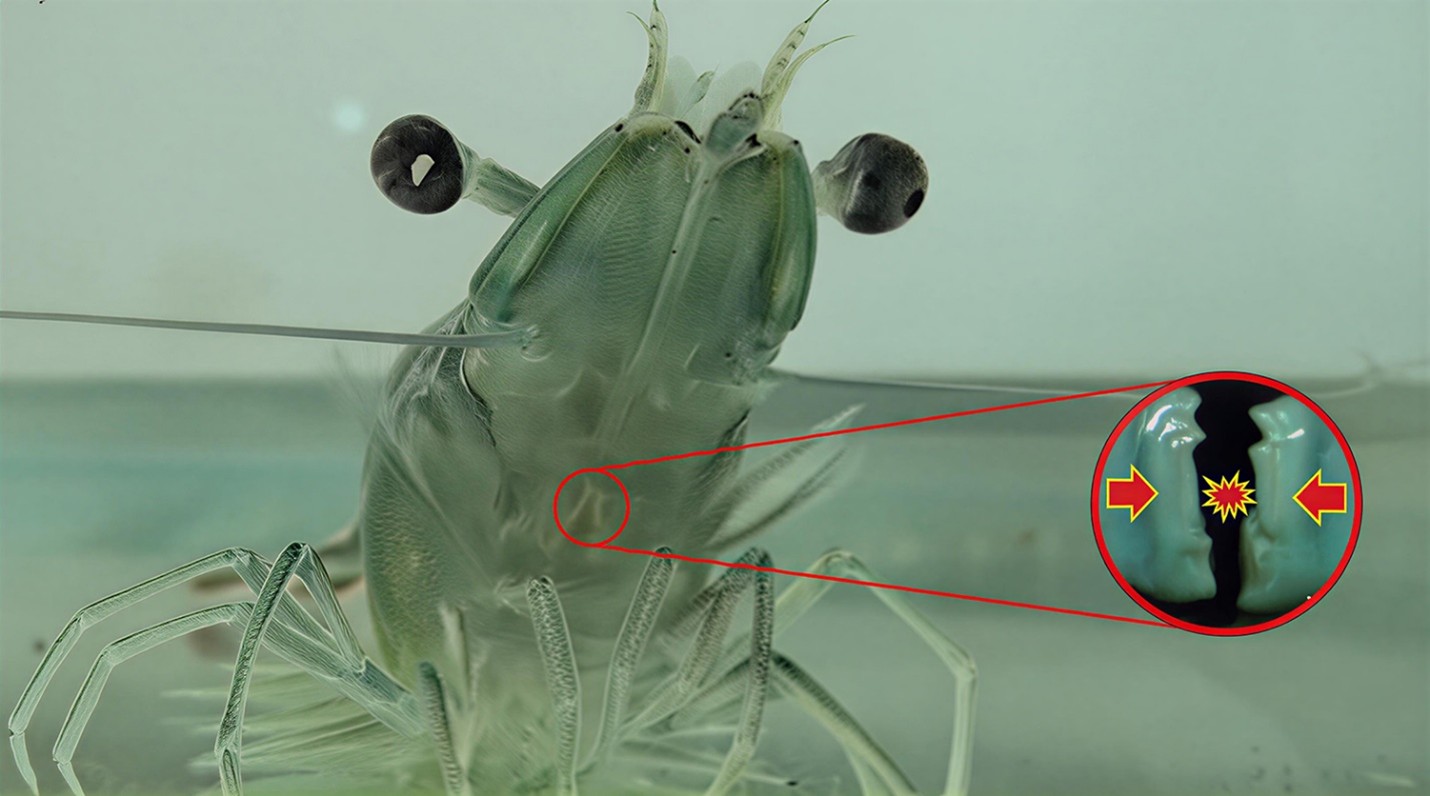
To overcome this visibility barrier, scientists and industry have started literally listening shrimp feeding activity using bioacoustics, more specifically “Passive Acoustic Monitoring (PAM). As shrimp feed, their mandibles collide to break the pellets, emitting distinct high frequency “clicks” (Fig. 1). On-demand acoustic feeders use sensitive underwater hydrophones and intelligent algorithms to detect these sounds in real time. This mechanism allows the system to autonomously dispense the exact amount of feed needed, precisely when shrimp show appetite, effectively eliminating guesswork in feeding management. For additional information on this topic, refer to the comprehensive reviews by Reis et al. (2022), and Peixoto and Soares (2025).
Superior field performance
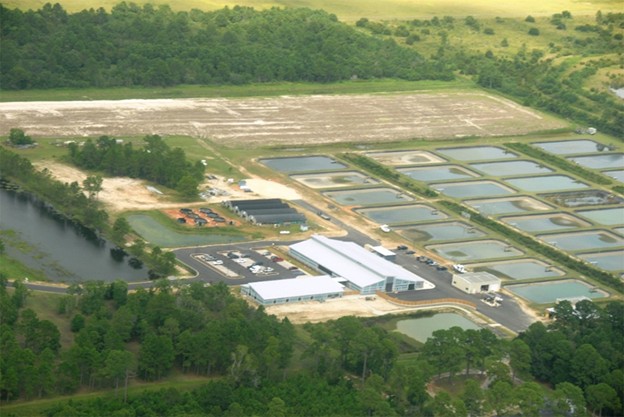
The transition from manual to automated feeding has demonstrated striking results for the feed management and economic viability of shrimp operations. Landmark studies evaluating the zootechnical performance of acoustic feeding systems at the Claude Peteet Mariculture Center (CPMC), Auburn University’s (AU) renowned research facility in Alabama (USA) (Fig. 2), showed that shrimp achieve greater growth in a significantly shorter period compared to traditional manual feeding methods.
By dispersing feed exclusively when there is a biological demand, passive acoustic systems consistently deliver lower feed conversion ratios (FCRs), larger harvest sizes and substantially higher overall yields. Trials have shown that these intelligent systems maximize the genetic growth potential of shrimp stock, allowing producers to reach commercial harvest sizes in condensed production cycles.
Because the system adapts to the animals’ real-time appetite, total feed inputs can safely be increased without the typical waste of uneaten pellets. This precision efficiency not only minimizes economic loss but also actively protects water quality by preventing the accumulation of decaying feed on the pond bottom. However, farmers must be prepared for the metabolic consequences of this accelerated growth; the increased biological load and rapid consumption rates require robust, automated aeration systems to effectively manage the higher oxygen demands of the pond.
From the field to the laboratory
With proven success on commercial farms, acoustic technology is also opening new frontiers in laboratory research, when it actually started more than a decade ago with the first studies on sound emission mechanism and PAM applications for black tiger shrimp (Penaeus monodon). In recent years, the Aquaculture Technology Laboratory at the Federal Rural University of Pernambuco (UFRPE) and the E. W. Shell Fisheries Center at AU are pioneers in studying multiple applications of PAM to analyze the feeding behavior of P. vannamei under controlled research conditions.
Thanks to those researchers, we now have access to information that is not provided by the industry producing acoustic demand feeders, such as the fact that the click sound parameters could change based on the physical properties of the feed, particularly for extruded and pelleted diets, different diameter and length of the pellets. For example, longer pellets require more mandibular effort and a greater number of clicks to be fully consumed, while hard texture feeds generate higher-energy acoustic signals.
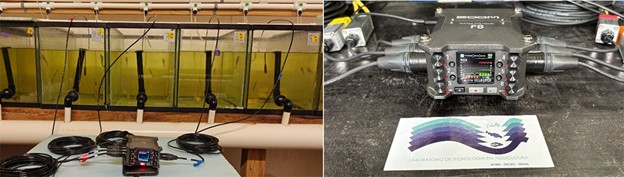
Another potential application of PAM laboratory research is testing different feed formulations (Fig. 3). In this case, acoustic responses can serve as an immediate proxy to evaluate feed palatability, allowing diets to be screened before being evaluated under farming conditions. For example, it has been suggested that diets enriched with marine attractants, such as krill oil or fish hydrolysate, consistently trigger much faster and longer-lasting click emissions than standard basal feeds.
In addition to the feed itself, the acoustic data reveals important behavioral changes throughout shrimp life stages and size classes. Larger shrimps are noticeably more voracious, concentrating their clicks in a rapid sequence during the first minutes of feeding, while smaller shrimps consume at a more steady and slower pace. Furthermore, since the volume of clicks and/or acoustic energy is directly proportional to shrimp stocking density, researchers believe that acoustic data could be calibrated to estimate the total population in the ponds or quickly detect sudden mortality events, adding a crucial layer of biosecurity to the operation.
The impact of water temperature on feeding dynamics
Along with feed formulation and management practices, recent bioacoustic research reveals how environmental factors, particularly water temperature, drive shrimp feeding behavior. In a recent laboratory trial, researchers evaluated P. vannamei juveniles exposed to a thermal gradient ranging from 22.1 to 31.3 degrees-C. By monitoring their acoustic clicks captured using a hydrophone and an audio recorder and actual food consumption over 30-minute feeding periods, the study captured the real-time metabolic response of the animals.
The results revealed that temperature not only dictates how much shrimp eat, but how they eat. As shown in Fig. 4, both feed intake and acoustic activity peaked within the optimal warm range of 27.5 to 31.3 degrees-C but declined significantly under cold conditions (22.1 and 24.1 degrees-C).
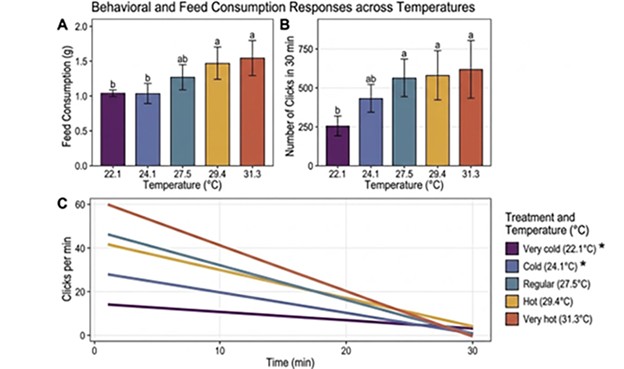
Continuous acoustic monitoring demonstrated that temperature fundamentally reshapes the temporal pattern of feeding. In warmer waters, shrimp exhibit a rapid, intense burst of feeding right after feed delivery, followed by a sharp decline in click rates as they reach satiety. Conversely, in colder waters, this burst is absent as the animals feed at a much lower, flatter and suppressed pace throughout the entire period.
These data reinforce that acoustic technology is not just a feed distribution tool, but an advanced biosensor. It actively translates the animal’s metabolic state and thermal comfort into actionable data, paving the way for truly intelligent, demand-based feeding systems that adapt to shifting environmental conditions.
The impact of dissolved oxygen on appetite
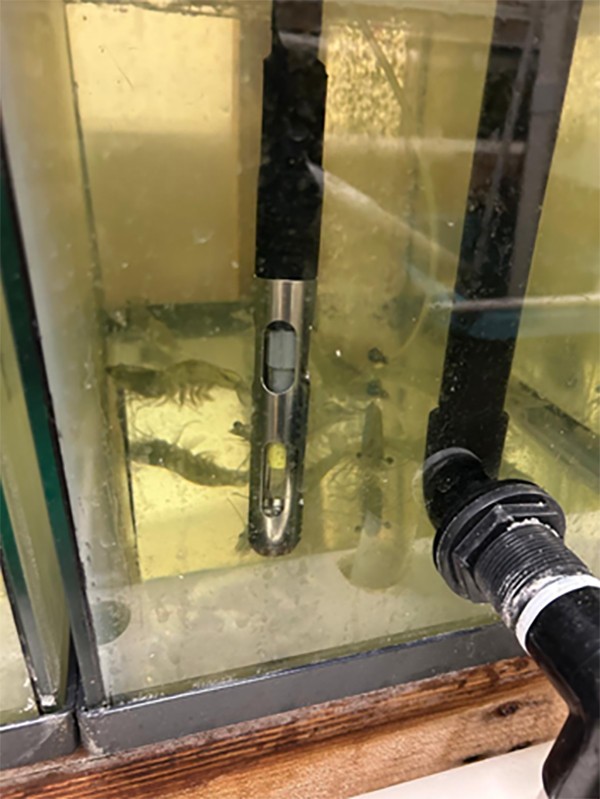
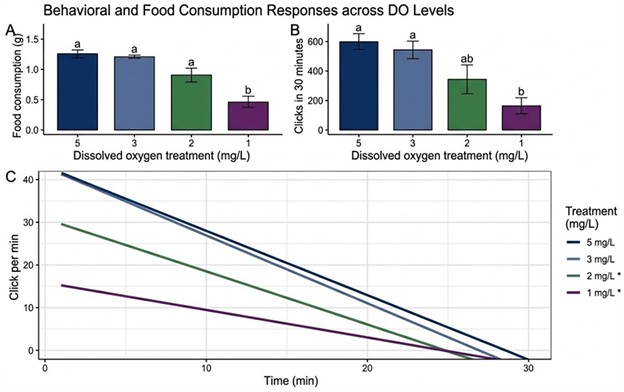
Just as temperature dictates the feeding rhythm, dissolved oxygen (DO) acts as a critical bottleneck for shrimp appetite. To quantify this impact, researchers have used PAM to assess P. vannamei feeding behavior at four different DO concentrations: 5, 3, 2 and 1 mg per L (Fig. 5). This allowed them to understand the real dynamics of oxygen depletion by simulating natural oxygen drops in ponds through aeration interruption.
Acoustic data, along with feed intake metrics, revealed a clear threshold for hypoxic stress. The shrimp’s feeding behavior remained surprisingly resilient, maintaining stable feed intake and acoustic click rates from the optimal level of 5 mg per L to 3 mg per L. However, a drastic behavioral change occurred when DO reached the severe hypoxic level of 2 and 1 mg per L, where both the intensity of acoustic clicks and total feed intake dropped significantly compared to the baseline level (Fig. 6A, B).
Furthermore, continuous monitoring revealed how hypoxia alters the temporal pattern of feeding (Fig. 6C). Under normal aeration (5 mg per L), the shrimp’s click frequency remained stable throughout the feeding period. In contrast, under hypoxic stress, the shrimp exhibited a completely different strategy: They showed an initial peak in feeding activity, followed by a rapid and sharp decline in click frequency, as metabolic constraints forced them into a suppression mode for energy conservation.
This sharp drop in acoustic activity highlights how severe hypoxia fundamentally suppresses the shrimp’s metabolic drive to feed. By using acoustic technology as a real-time sensor, producers can detect these behavioral changes during low-oxygen events. This allows for immediate, data-driven management decisions such as pausing automated feed distribution when aeration systems fail or DO (dissolved oxygen) drops to dangerous levels, ultimately preventing massive feed waste and protecting the pond bottom from further deterioration.
Conclusion
The integration of bioacoustics in shrimp farming represents a vital shift from traditional, reactive feed management to a proactive, precision-driven approach. By interpreting shrimp feeding sounds into data, acoustic monitoring effectively overcomes the challenges inherent in high turbidity pond waters. This technology not only optimizes growth rates and reduces the economic and environmental costs associated with feed waste but also serves as an advanced real-time biosensor. As demonstrated by its sensitivity to temperature fluctuations and reduced dissolved oxygen, PAM allows producers to detect physiological stress and adapt management strategies instantly. In short, PAM protects water quality, maximizes farm profitability and paves the way for a more sustainable and intelligent future in global shrimp production.
By Fábio Costa Filho, MS Indira Medina Torres D. Allen Davis, Ph.D. Giáo sư Tiến sĩ Silvio Peixoto
Read more:
SẢN PHẨM PHỤC VỤ NỀN NÔNG NGHIỆP XANH
TIN TỨC NỔI BẬT
A comparison of resource use in shrimp farming, part 3: Energy
Shrimp farming in the five major exporting countries could use less energy by focusing on [...]
Sep
A comparison of resource use in shrimp farming, part 2: Water
Shrimp farming uses very little freshwater directly – only that required for drinking purposes, sanitation [...]
Sep
A comparison of resource use in shrimp farming, part 1: Land
The intensity of shrimp production could be greatly increased without any additional direct land use [...]
Sep
Study finds marine amphipods can upcycle crop waste into aquaculture feeds
Researchers found marine amphipods can convert agricultural waste into nutritious ingredient for aquaculture feeds Researchers [...]
Sep
Water quality impacts on health and performance of fish and shrimp, Part 3: The nitrogenous compounds ammonia, nitrite and nitrate
Effective monitoring and management of ammonia, nitrite and nitrate are essential in intensive aquaculture systems, [...]
Sep
Nitrogen isotopes help researchers verify fishmeal sources for aquafeeds
Nitrogen isotope signatures can verify fishmeal use in aquaculture diets, potentially improving seafood traceability Researchers [...]
Aug
Water quality impacts on health and performance of fish and shrimp, Part 2: pH, carbon dioxide, alkalinity, hardness and the water buffering system
Although there is a general consensus on the importance of water quality, many farmers still [...]
Aug
Impact of Novel Feed Ingredients on Growth, Digestibility, Enzymes, and Gene Expression in Pacific White Shrimp, Penaeus vannamei
As aquaculture strives for sustainability, replacing fish meal in shrimp diets remains a challenge. This [...]
Jul
Effects of Shrimp Aquaculture on Mangrove Soil Carbon Stocks and Sustained-Flux Global Warming Potentials
Mangrove forests provide critical ecosystem services, including serving as nursery habitats for fish, protecting coastlines [...]
Jul
Warming-Driven Migration of Enterotypes Mediates Host Health and Disease Statuses in Ectotherm Litopenaeus vannamei
With modern industrialization and urbanization, global warming has become a serious threat to ecosystems, especially [...]
Jul
Pivotal Roles of Fish Nutrition and Feeding: Recent Advances and Future Outlook for Brazilian Fish Farming
As global aquaculture shifts toward ecological responsibility, Brazil’s nutritional strategies are evolving to reduce reliance on [...]
Jul
Analyze of Production Performance of Shrimp Litopenaeus vannamei Culture and Water Quality on Earthen Pond Quality on Earthen Pond and HDPE-Lined Pond
As global demand for seafood continues to rise, aquaculture faces increasing pressure to optimize production [...]
Jul