
 Tiếng Việt
 中文 (中国)

New research has found the aquaculture industry will fail to satisfy growing consumer demands – leaving a 50 million tonne supply gap by 2050 – unless it diversifies towards regenerative aquaculture.
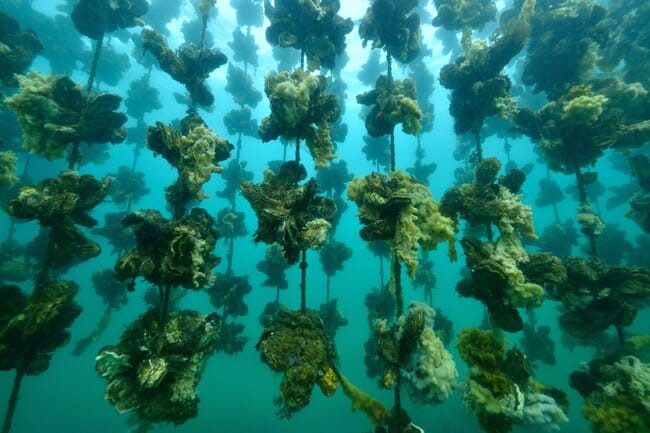
Oysters growing at an oyster farm
Increasing the cultivation of bivalve species such as oysters would help close the projected supply gap while also tackling biodiversity risks
According to a new report published by non-profit financial think tank Planet Tracker, even in the most optimistic scenario of improving current aquaculture practices, a 50 million tonne supply gap would still exist by 2050, meaning change is critical.
Analysis by Planet Tracker found that while technological solutions – such as farming seafood offshore, or on land or growing fish in labs – could contribute up to 5 million additional tonnes of seafood by 2050, embracing regenerative aquaculture – the production of food from the sea that provide benefits to the ecosystem, such as water filtering by bivalves (eg oysters, mussels and clams) or carbon sequestration by seaweed – could produce an additional 45 million tonnes of seafood and meet growing demand.
However, the report – Avoiding Aquafailure: aquaculture diversification and regeneration are needed to feed the world – reveals that at least $55 billion is needed in capital expenditure to finance this transition, which most aquaculture companies cannot afford.
The report signals that a business-as-usual approach with concentrated fish monocultures will lead to a variety of biodiversity risks, with impacts from nutrients pollution to native species displacement, resulting in financial losses to the industry. Latest research finds an increasingly concentrated industry with the top ten seafood-producing counties accounting for 89% of the total seafood production – and over 75% of listed aquaculture companies farming salmon, shrimp or pangasius.
As François Mosnier, head of oceans programme at Planet Tracker, explained in a press release: “On land, the conversion of natural habitat into monoculture is widely recognised as a key driver of biodiversity loss, but less acknowledged are the similar patterns affecting marine life due to monoculture fish farming. Unsustainable seafood production will not feed the world by 2050, but the good news is that an aquaculture industry that is resilient, productive and environmentally sustainable can be built.”
The report calls on investors and lenders to finance this regenerative transition by:
- Being aware of the increasing risks to production in a business-as-usual scenario due to concentration, coastal conflict, production at intensities above sustainable limits and upcoming regulatory pressures.
- Demanding better disclosure, transparency and traceability procedures from companies to assist in better quantification and mitigation of these risks.
- Supporting the mitigation of these risks through diversification of species and geographic distribution, especially if the species involved allow ecosystem restoration and provided that expansion in new areas does not increase the company’s impact on biodiversity investments.
- Supporting the mitigation of these risks through technology which enables offshore, RAS and cultivated seafood, but only if it is environmentally sound to do so.
- Supporting regenerative aquaculture investments, for instance by offering cheaper capital for sustainable expansion, including via sustainability-linked bonds.
By The Fish Site
Reference: https://thefishsite.com/articles/regenerative-aquaculture-crucial-to-avoid-seafood-shortage-by-2050
DOMESTICATED SHRIMP POSTLARVAE – THE KEY TO SUCCESS
See more:
- Is EHP now the key health concern for Asian shrimp producers?
- AI Chatbots and Aquaculture Professionalism
- Can this breeding technique breathe new life into giant freshwater prawn farming?
SẢN PHẨM PHỤC VỤ NỀN NÔNG NGHIỆP XANH
TIN TỨC NỔI BẬT
A comparison of resource use in shrimp farming, part 3: Energy
Shrimp farming in the five major exporting countries could use less energy by focusing on [...]
Sep
A comparison of resource use in shrimp farming, part 2: Water
Shrimp farming uses very little freshwater directly – only that required for drinking purposes, sanitation [...]
Sep
A comparison of resource use in shrimp farming, part 1: Land
The intensity of shrimp production could be greatly increased without any additional direct land use [...]
Sep
Study finds marine amphipods can upcycle crop waste into aquaculture feeds
Researchers found marine amphipods can convert agricultural waste into nutritious ingredient for aquaculture feeds Researchers [...]
Sep
Water quality impacts on health and performance of fish and shrimp, Part 3: The nitrogenous compounds ammonia, nitrite and nitrate
Effective monitoring and management of ammonia, nitrite and nitrate are essential in intensive aquaculture systems, [...]
Sep
Nitrogen isotopes help researchers verify fishmeal sources for aquafeeds
Nitrogen isotope signatures can verify fishmeal use in aquaculture diets, potentially improving seafood traceability Researchers [...]
Aug
Water quality impacts on health and performance of fish and shrimp, Part 2: pH, carbon dioxide, alkalinity, hardness and the water buffering system
Although there is a general consensus on the importance of water quality, many farmers still [...]
Aug
Impact of Novel Feed Ingredients on Growth, Digestibility, Enzymes, and Gene Expression in Pacific White Shrimp, Penaeus vannamei
As aquaculture strives for sustainability, replacing fish meal in shrimp diets remains a challenge. This [...]
Jul
Effects of Shrimp Aquaculture on Mangrove Soil Carbon Stocks and Sustained-Flux Global Warming Potentials
Mangrove forests provide critical ecosystem services, including serving as nursery habitats for fish, protecting coastlines [...]
Jul
Warming-Driven Migration of Enterotypes Mediates Host Health and Disease Statuses in Ectotherm Litopenaeus vannamei
With modern industrialization and urbanization, global warming has become a serious threat to ecosystems, especially [...]
Jul
Pivotal Roles of Fish Nutrition and Feeding: Recent Advances and Future Outlook for Brazilian Fish Farming
As global aquaculture shifts toward ecological responsibility, Brazil’s nutritional strategies are evolving to reduce reliance on [...]
Jul
Analyze of Production Performance of Shrimp Litopenaeus vannamei Culture and Water Quality on Earthen Pond Quality on Earthen Pond and HDPE-Lined Pond
As global demand for seafood continues to rise, aquaculture faces increasing pressure to optimize production [...]
Jul